A Two-Phase Plan to Transform Aviation Technology
The BNATCS initiative is designed to accelerate modernization across four principal technology areas: automation, communications, surveillance, and weather monitoring.
The first phase encompasses 13 programs, with completion targeted for December 2028. Many of these efforts build upon existing FAA modernization initiatives but dramatically accelerate their deployment schedules.
Among the most significant planned improvements are:
- Communications modernization: Replace 5,170 aging copper telecommunications lines with fiber-optic infrastructure and transition nearly 30,000 services to Internet Protocol communications.
- Digital voice systems: Replace 450 legacy voice switches and modernize radio equipment at 1,581 sites, accelerating some previously planned improvements by nearly nine years.
- Surveillance improvements: Modernize electronic components of 612 radars, install 53 updated surface movement radars, and expand airport surface awareness capabilities to 220 airports.
- Automation upgrades: Deploy integrated information displays at 435 locations and electronic flight strips at 89 airports.
- Weather and training technologies: Expand weather cameras, observation systems, Alaska flight service automation, and simulation-based training at 117 control towers.
These improvements are intended to replace vulnerable legacy technologies while giving controllers more reliable, integrated information for managing aircraft movements.
The second phase would pursue more advanced automation capabilities to track aircraft and optimize air traffic management. However, GAO reports that the FAA has not established a schedule for beginning or completing this phase.
A Multibillion-Dollar Investment With Uncertain Total Costs
Congress appropriated $12.5 billion in July 2025 to support the modernization initiative, including approximately $9 billion for air traffic control systems and $3.5 billion for facilities construction.
FAA’s June 2026 estimates projected approximately $10.6 billion for first-phase systems modernization and an additional $10.2 billion for second-phase systems work, excluding facilities.
Reported funding and cost figures
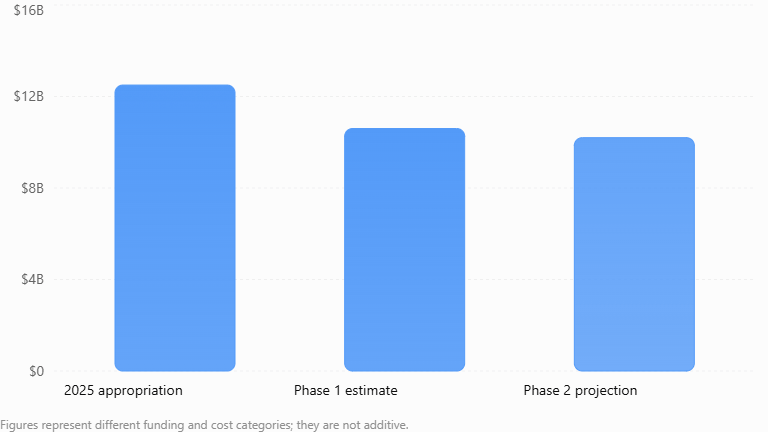
Figures represent different funding and cost categories; they are not additive.
Source: GAO-26-107992. The appropriation includes $3.5 billion for facilities; phase estimates concern systems modernization and exclude various lifecycle costs.
GAO’s central concern is that these estimates do not reflect the full costs of developing, implementing, operating, maintaining, and eventually replacing the new systems.
The FAA’s initial estimates excluded government-related costs, most long-term operations and maintenance expenses, and detailed costs for the second phase. GAO also found that FAA officials could not provide the underlying analysis needed to substantiate the first-phase estimates.
Consequently, the $10.6 billion figure should not be interpreted as a comprehensive estimate of the program’s ultimate cost.
The report emphasizes that credible lifecycle cost estimates are essential for congressional oversight, annual budget decisions, contractor accountability, and long-term financial planning.
Early Progress Demonstrates the Potential for Rapid Modernization
Despite these concerns, GAO identifies measurable progress in implementing the first phase.
As of May 2026, FAA reported replacing 2,560 of 5,170 aging copper telecommunications lines with modern fiber-optic infrastructure—approximately half of the planned total. The agency also reported progress across nine of the 13 modernization programs, including work on radio systems.
These achievements demonstrate that accelerating existing technology investments can produce tangible results.
However, completing the remaining work by December 2028 will require an unprecedented deployment pace across thousands of aviation facilities.
The Scheduling Challenge: Coordinating More Than 11,000 Projects
One of GAO’s most significant findings concerns the FAA’s approach to coordinating thousands of individual modernization projects.
As of May 2026, the agency had 11,389 separate project schedules supporting the 13 first-phase programs. However, these schedules had not been integrated into a comprehensive master schedule capable of identifying interdependencies, potential conflicts, or opportunities to coordinate installation activities.
This creates the possibility that multiple contractors could visit the same aviation facility at different times to perform related modernization work, increasing costs and disrupting air traffic control operations.
GAO cited a facility in St. Louis, Missouri, where voice-switch installation preparation was scheduled for April 2027, followed by information-display installation preparation approximately eight months later.
A coordinated approach could potentially reduce repeated site visits, streamline contractor activities, and minimize operational disruptions.
FAA officials indicated that they were exploring an artificial intelligence-based scheduling tool to identify conflicts and improve coordination. However, at the time of GAO’s review, the tool remained under development and testing, and its effectiveness had not been established.
This finding highlights a broader challenge in federal technology acquisition: accelerating deployment without coordinating individual projects can create inefficiencies that ultimately undermine the intended schedule.
Lessons From Four Decades of Modernization Efforts
GAO places the BNATCS initiative within a longer history of federal efforts to modernize air traffic control.
Since the 1980s, the FAA has pursued major initiatives intended to improve aviation safety, introduce automation, and expand the capacity of the national airspace system.
These efforts have frequently encountered technical complexity, funding limitations, changing requirements, and contractor management challenges.
The FAA’s Next Generation Air Transportation System, commonly known as NextGen, illustrates these difficulties. Initially expected to be completed by 2025, NextGen was subsequently projected to continue until at least 2030.
GAO reported that the FAA spent more than $14 billion on NextGen between fiscal years 2007 and 2022, with combined federal and industry costs projected to reach at least $35 billion through 2030.
Drawing on this history, GAO identifies several recurring management weaknesses, including insufficiently defined requirements, inadequate stakeholder involvement, contractor oversight deficiencies, funding shortfalls, and overly optimistic estimates.
The lesson is that technology modernization requires more than acquiring advanced equipment. It also demands disciplined systems engineering, realistic financial planning, coordinated implementation, and effective program oversight.
GAO Calls for Two Management Improvements
GAO makes two principal recommendations to strengthen the FAA’s modernization initiative.
First, the FAA should develop a comprehensive lifecycle cost estimate consistent with GAO’s established cost-estimating best practices. This would provide decision-makers with a more reliable understanding of the full financial requirements of the initiative, including development, procurement, operations, maintenance, and eventual system replacement.
Second, the FAA should establish a detailed integrated master schedule for the first phase of BNATCS. Such a schedule would coordinate activities across contractors, projects, and facilities while identifying critical dependencies and potential implementation conflicts.
The Department of Transportation partially concurred with both recommendations. It maintained that the FAA had developed program-level cost estimates and scheduling capabilities, including an AI-enabled coordination tool.
GAO nevertheless concluded that the documentation and planning available during its review did not satisfy established best practices and that both recommendations remained necessary.
Implications for Federal Technology Modernization
Although the report focuses specifically on air traffic control, its findings have broader implications for federal technology acquisition and infrastructure modernization.
The federal government is increasingly pursuing large-scale modernization initiatives involving advanced communications, digital infrastructure, automation, and integrated information systems. These efforts often require coordinating multiple contractors, legacy technologies, operational facilities, and funding sources.
The BNATCS experience illustrates three important considerations.
First, modernization speed and management discipline must advance together. Accelerated procurement and deployment can deliver important benefits, but compressed schedules may introduce risks when testing, integration, and operational coordination are not adequately addressed.
Second, systems integration is as important as individual technology improvements. Replacing outdated communications equipment, radar systems, and automation platforms will produce the greatest benefits when the technologies operate together reliably across the national airspace system.
Third, long-term investment planning is essential to sustaining modernization gains. The acquisition of new systems represents only part of their lifecycle costs. Agencies must also account for maintenance, cybersecurity, technical upgrades, workforce training, and eventual replacement.
These considerations are particularly relevant as federal agencies seek to incorporate emerging technologies, including artificial intelligence and advanced digital communications, into mission-critical infrastructure.
The Path Forward
GAO’s September 2026 report presents a balanced assessment of the FAA’s modernization initiative.
The need for replacing aging air traffic control infrastructure is urgent, and the agency has demonstrated meaningful early progress. Accelerating the deployment of modern communications, surveillance, weather monitoring, and automation technologies could improve the reliability and efficiency of the nation’s aviation system.
However, GAO cautions that the initiative’s ambitious timeline and substantial financial commitments must be supported by credible cost estimates and integrated implementation planning.
The central challenge is not simply whether the FAA can deploy new technologies more rapidly. It is whether the agency can coordinate a nationwide transformation of mission-critical aviation infrastructure while controlling costs, minimizing disruptions, and maintaining safety.
Ultimately, the success of the Brand New Air Traffic Control System initiative will depend on combining technological innovation with the management discipline necessary to deliver reliable, sustainable improvements to the national airspace system.
Source: U.S. Government Accountability Office, Air Traffic Control Systems: Ambitious New Modernization Effort Needs to Improve Cost and Schedule Planning, GAO-26-107992, September 14, 2026. This blog post is based on the uploaded report, particularly its executive highlights, modernization plans, cost and schedule findings, and recommendations.